Supporting the Right Source and Right Place
Cover crops retain nutrients, build soil health, and protect water quality — while supporting long-term farm profitability.
What It Is
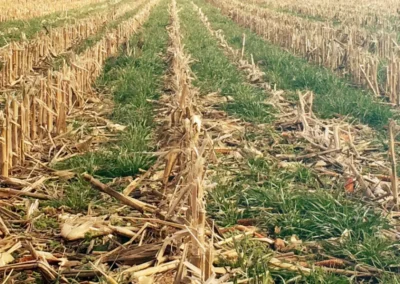
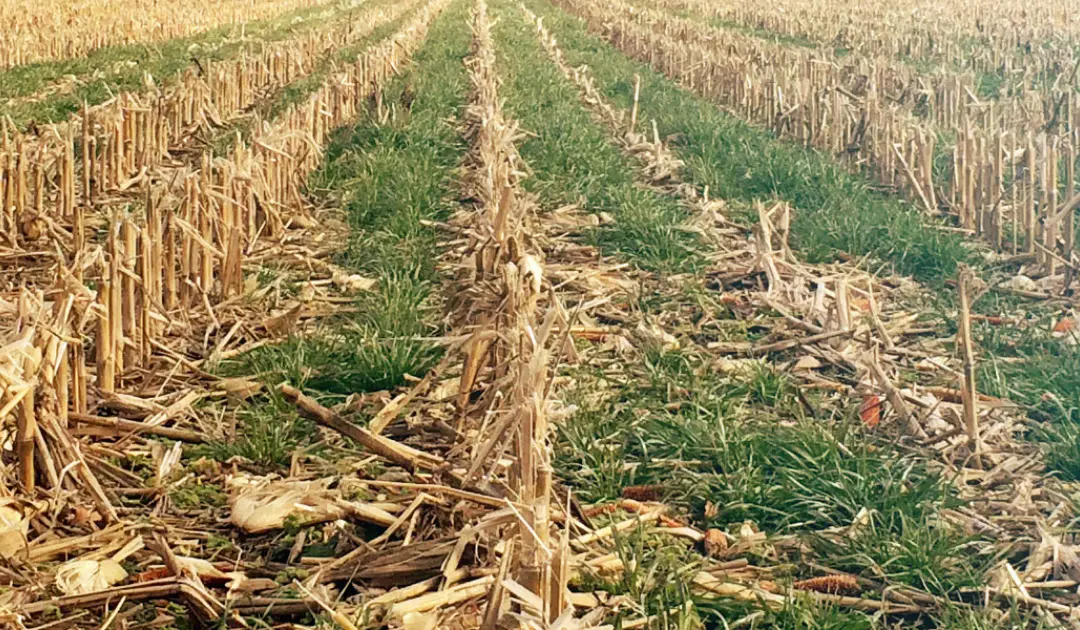
Cover crops are planted between cash crops to take up leftover nutrients, protect the soil, and support long-term soil health. They keep fields covered over the winter, maintain living roots in the soil, and add diversity to crop rotations.
What to Expect
- Tailored performance → Different species and mixes provide benefits like nutrient cycling, weed suppression, and erosion control.
- Improved soil health → More diversity + more organic matter = healthier soils that hold water and nutrients better.
- Management matters → Cover crops should be managed like cash crops. Early planting increases fall growth and nitrogen uptake, while later termination supports higher biomass and weed suppression.
Proven Benefits
- Rye reduced nitrate loss to groundwater by 80% in Queenstown, MD (Staver & Brinsfield, 1998).
- Hairy vetch fixed 1.8 lb N/acre/day, adding 60 lb N/acre for the next crop (Clark et al., 1995).
- Mixed species stands balance nutrient release — slower than hairy vetch, faster than rye (Poffenbarger et al., 2015).
- Forage radish can take up 100–150 lb N/acre if planted early, but decomposes rapidly; pairing with hardy species extends cover into spring (Dean & Weil, 2009).
Cover Crops in Action
Researchers and farmers in the Mid-Atlantic have studied cover crops for decades. Demonstrations in Delaware show that earlier establishment (September vs. October or November) leads to much stronger nitrogen uptake and storage through winter.
Getting Started
- Start by identifying your main goal: nitrogen uptake, weed suppression, erosion reduction, compaction management, or soil building.
- Work with your advisor to choose species or mixes that fit your cropping system.
- Use tools and resources to guide decisions:
- Managing Cover Crops Profitably (SARE) [Free online book]
- Cover Crops and Soil Health (USDA NRCS)
- Cover Crops Factsheet (Delaware-Maryland 4R Alliance)